

Sinan Kocbag | Adrian Kalanderi | Youssef Ouali | Tim Oosterling
Client: Bouldercentrum Delfts Bleau
Location: Delft
Date: 29-06-2026
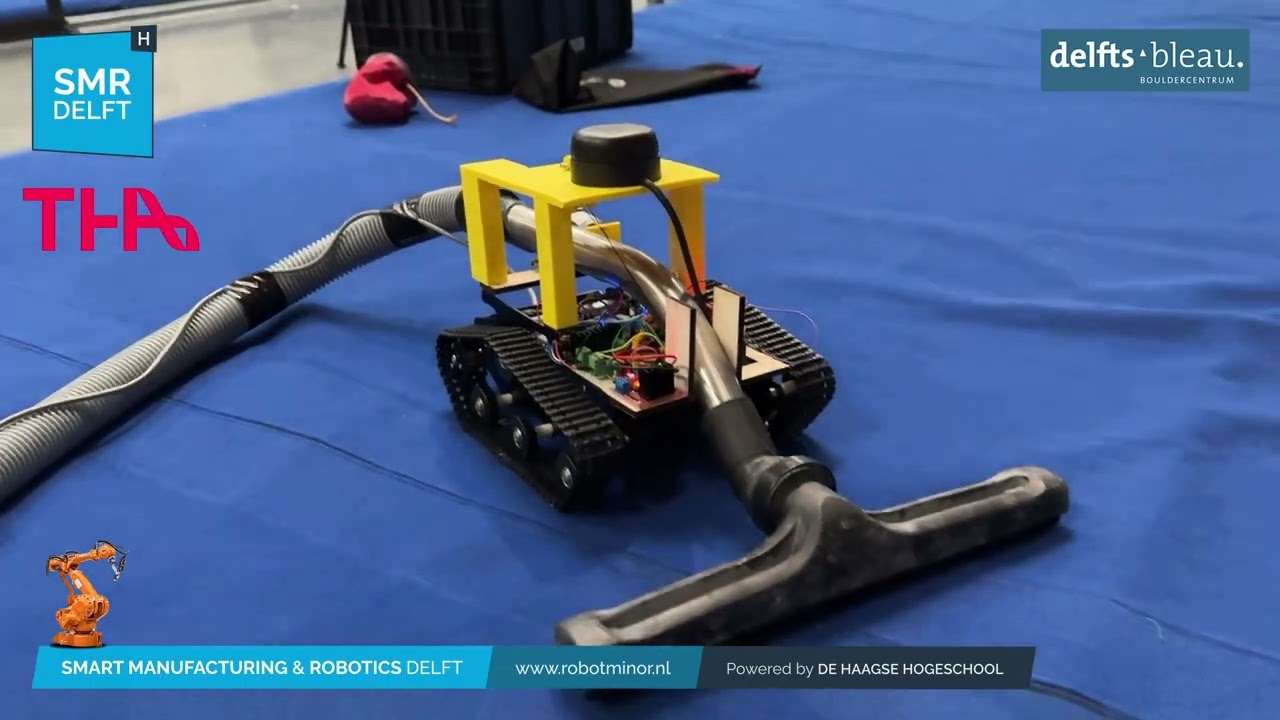
The Hague University of Applied Sciences is developing a tracked mobile robot that automates the cleaning of bouldering mats, moving a vacuum hose across the surface so every part gets cleaned without anyone having to drag a hose by hand.
Current Situation
Bouldering mats are cleaned manually today: an operator drags a heavy vacuum hose across the mats by hand. It’s repetitive work that has to be repeated constantly, as chalk dust builds up fast in busy climbing gyms.
Problem
Repetitive manual cleaning
Dragging a hose across large, irregular mat layouts by hand takes time and effort better spent elsewhere.
Risk of incomplete coverage
Skipped or double-covered sections leave chalk residue behind.
Unstable, deformable surface
Soft mats with wrinkles and gaps make it easy for a moving system to drift, lose traction, or get stuck.
No fixed layout
Boulders and routes change regularly, so the cleaning area itself keeps changing shape.
Solution
A tracked robot moves only the hose-end across the mats, while the heavy vacuum unit stays fixed off to the side. Tracks keep it stable on soft, uneven terrain, and an onboard IMU paired with a Jetson Nano and Arduino Nano control setup lets it drive its planned routes reliably.
How the System Works
Vacuum hose decoupling — Only the lightweight hose-end moves across the mat; the vacuum itself stays off it entirely.
Tracked locomotion — Tracks give better traction and stability than wheels on soft, wrinkled mats.
Distributed control — The Arduino Nano drives the motors while the Jetson Nano handles navigation, keeping the system simple and easy to expand.
Onboard orientation tracking — An IMU gives the robot a sense of its own movement and orientation, the basis for accurate navigation.
Solid driving performance — The robot already drives straight, controlled paths both forward and backward.
Full coverage on the way — Sensor fusion and path-planning are the next step, aimed at guaranteeing complete cleaning coverage with no missed or repeated spots.
Conclusion
The SMR2 project shows that automating bouldering mat cleaning is a realistic goal, with a stable and capable platform already driving with confidence. The next step is turning that reliable movement into full, gap-free cleaning coverage.