

Automated brick sorting and palatizing line (KVDM)
November 2026, Smart Manufacturing & Robotics Minor, The Hague University of Applied Sciences
Niels Geerlings | Marc Leroy | Bas Molenaar | Thijs Vermaas
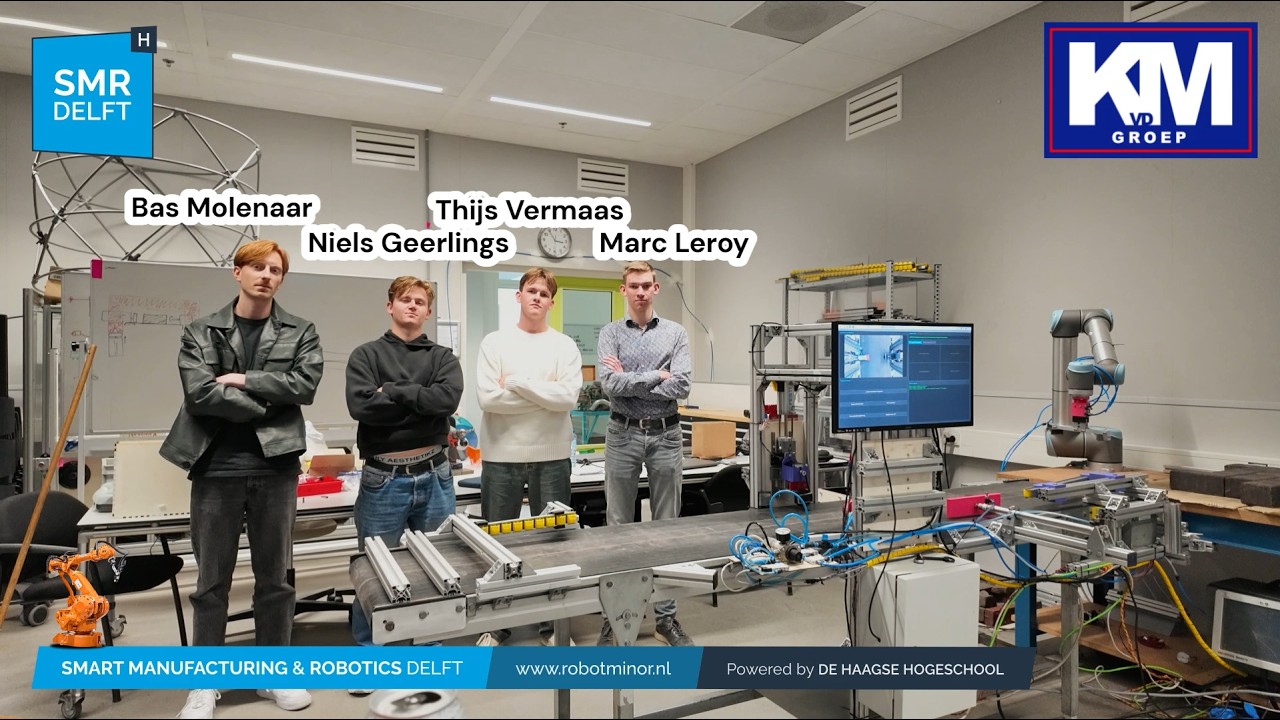
Context
As circularity becomes increasingly important, paving bricks are being reused instead of discarded. KVDM recycles these bricks by removing them from the ground, washing them, and inspecting their condition. Damaged bricks are removed from the process, while intact bricks are palletized again for reuse. The inspection and palletizing are currently performed manually, making the process labour-intensive and requiring several employees. For this reason, KVDM wanted to innovate and automate this part of the workflow.
What we built
To address this challenge, we developed an automated brick sorting and palletizing line. The bricks are fed in widthwise, and their orientation in this direction does not matter. The system transports the bricks on a conveyor belt.
When a brick passes a photo-electric sensor, the conveyor belt stops, positioning the brick directly underneath the camera. If a brick is too severely damaged to be lifted, the conveyor belt continues moving and transports it directly to the rejection point without being inspected.
For bricks that can be lifted, a pneumatic cylinder then extends to clamp the brick in place. Additional pneumatic cylinders lift the brick, allowing the camera to inspect it. A stepper motor rotates the brick so that all four sides can be inspected. The camera takes a picture of each side, and a classifier determines which surfaces are the top, bottom, and sides of the brick. The brick is then rotated again to scan it’s top and bottom surfaces using a 3D depth image. This allows the system to detect whether the brick is damaged or not.
After the inspection, the lifting cylinders extend and the clamping cylinder releases the brick. Based on the classifier’s output, the brick is always placed on the conveyor belt with its top side facing upwards. The brick continues along the conveyor belt towards the robotic arm. If the brick is damaged, a pneumatic cylinder pushes it off the conveyor belt halfway through the line and into a collection bin. If the brick is approved, it falls into a V-shaped buffer at the end of the conveyor belt. The robotic arm picks up the brick and places it on the pallet in the correct pattern.
What we recommend KVDM does next:
We recommend that KVDM further optimizes both the machine and its software. The system could be scaled up by placing multiple units in parallel, increasing the overall output.
The machine should also be made more robust for use in an industrial environment. This includes protecting vulnerable components as well as designing replaceable wear parts that can be easily maintained or replaced.
Finally, we recommend using the collected performance data to identify bottlenecks. The goal should be to further develop a reliable setup with the highest possible efficiency and output while maintaining accurate brick inspection and palletizing.