

Matthew Borkus | Thijs Keijzer | Stef van Velden | Teun Bruinen
COBOT AUTOMATION PROJECT SHOWS PROMISING RESULTS IN AUTOMATED TULE AND HEADREST PLACEMENT
September - November 2026
A collaborative robot (cobot) is being developed to automate the handling and placement of tules and headrests, with initial tests showing promising results and bringing the company closer to an efficient automated production process.
Context
As part of our project, we are exploring the possibilities of using a collaborative robot to automate the picking, handling and placement of tules and headrests. The goal is to develop a practical solution that can support the company’s production process, reduce manual handling and improve efficiency. Through brainstorming, concept development and practical testing, we are investigating how the cobot can best be integrated into the existing working environment.
The Challenge
Automating the placement of tules and headrests presents several challenges. The components need to be picked up, handled and positioned correctly before they can be placed. In particular, the orientation of the tules is important, as they need to be rotated into the correct position. Another challenge is developing a suitable method for picking up and placing the headrests. Finally, the solution needs to fit within the company’s existing workspace and production process to ensure practical implementation.
The Solution
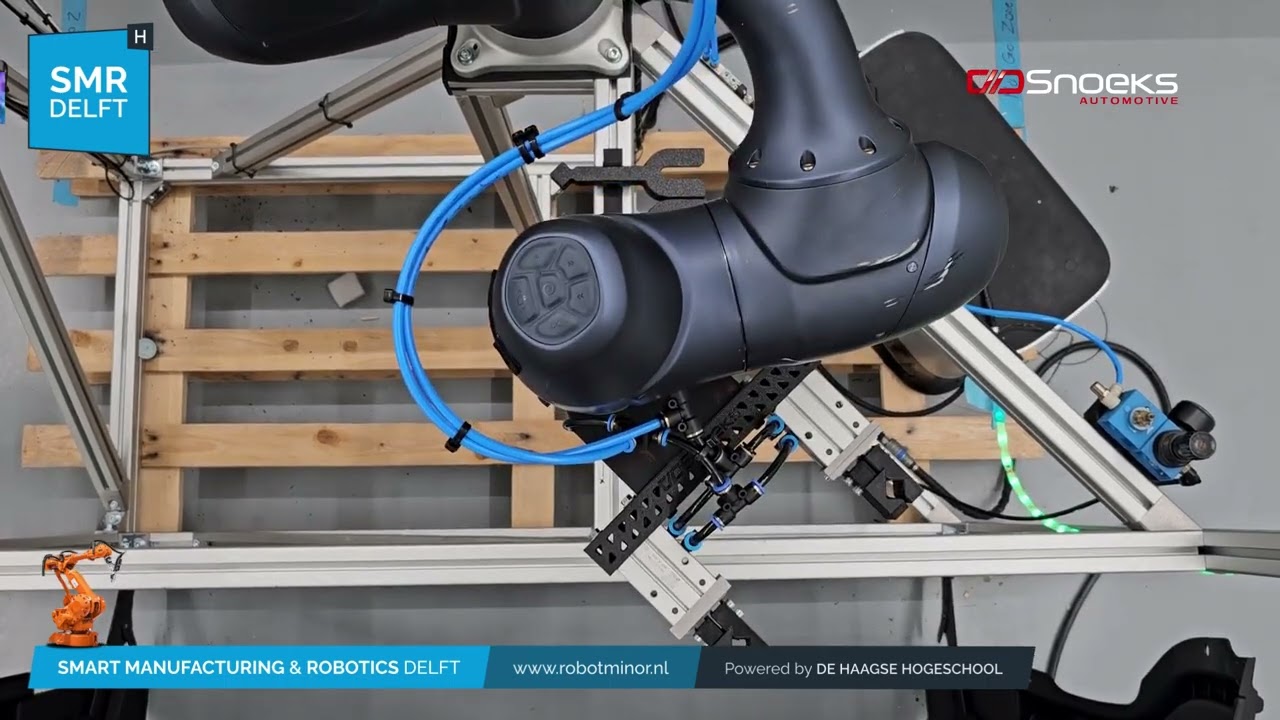
After brainstorming several possible approaches, we developed different concepts for lifting, picking up and placing the tules. To prepare for testing, we also built a small-scale model of the working environment. This allowed us to explore different setups and determine suitable locations for testing the cobot.
Once the cobot was installed, we started testing our concepts in practice. The first tests focused on picking up and placing the tules, with very positive results. These tests demonstrated that the proposed approach has potential and provides a solid foundation for further development.
How the System Works
The cobot is designed to pick up individual tules and place them in the required position. The next development step is to integrate vision technology, allowing the system to recognise the orientation of each tule and rotate it into the correct position before placement. In addition, we are working on a suitable method for the cobot to pick up and place the headrests.
Once both processes have been successfully developed and tested, we will investigate how to combine the different operations into a practical system that can be implemented within the company’s production environment.
What’s Next?
With the first successful tule placement tests completed, the project is moving into its next phase. Our focus will be on implementing vision-based rotation and developing the headrest handling process. The final step will be to evaluate the complete system and determine how it can be set up to provide real value for the company.