

Abolfazl Hamdard|Max Berbée|Romy van Beek
Bouldercentrum Delfts Bleau - Industrial robot vacuum cleaner, next phase (Delft) (Bouldercentrum Delfts Bleau)
Abolfazl Hamdard|Max Berbée|Romy van Beek
Client: Bouldercentrum Delfts Bleau, Schieweg 15L, 2627 AN Delft
Contact: Sander ter Steege, Owner
Demo day: (02-11-2026)
Who we are and what we are doing
We are three Smart Manufacturing & Robotics students from The Hague University of Applied Sciences. Over the course of this project, we are developing a prototype of an vacuum robot that aims to reduce manual work.
What was the situation
The vacuuming process requires manual operation and supervision. The operator has to handle and move the vacuum equipment to clean the required surfaces. This takes time and requires human involvement throughout the process.
The goal of this project was to investigate how this process can be automated using a robotic platform equipped with a vacuum base and navigation technology.
The problems, worst first
Manual operation and lack of automation: The process required human involvement. Automating the movement and vacuuming process could reduce manual work and improve efficiency.
Mechanical friction and traction: The vacuum hose, vacuum head and uneven sections of the mat create resistance. This can cause the robot’s wheels to lose traction and slip, making movement less reliable. But it has been tackled. Putting a sleeve on the hose wil make it even better.
System integration: The idea was that the robot base, vacuum head, sensors and electronics need to communicate and work together reliably. And now it does
What we built
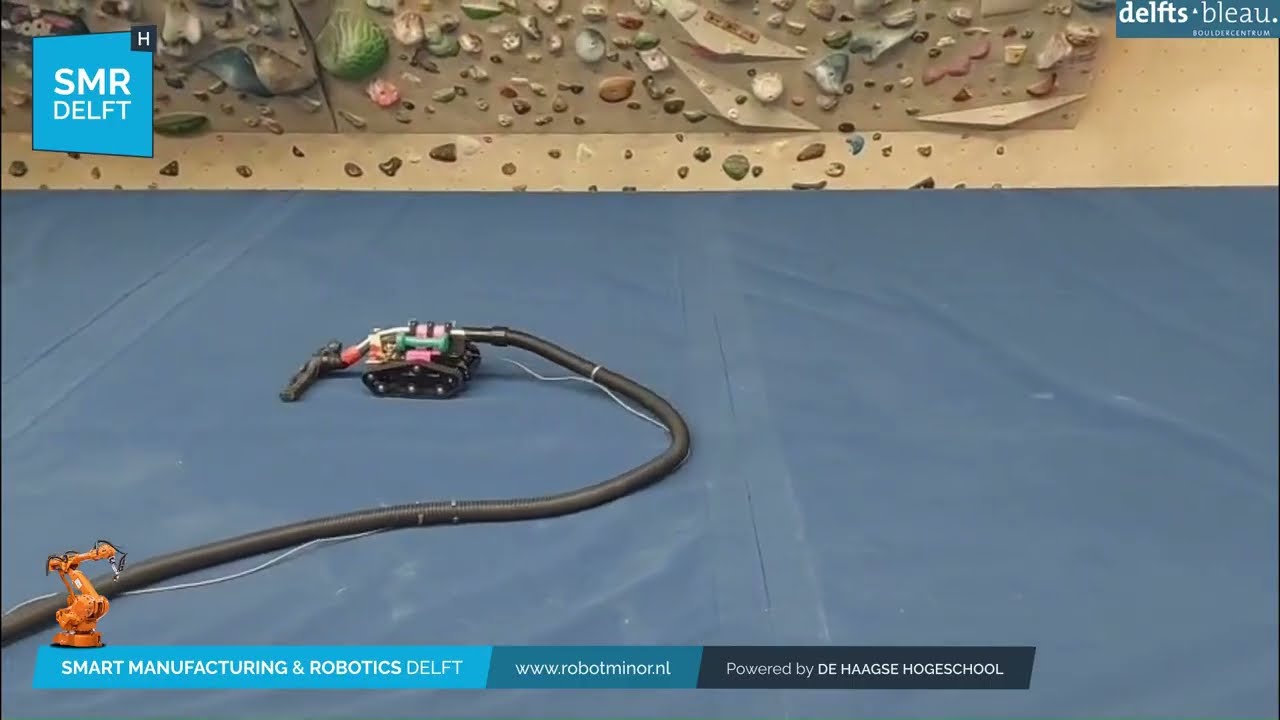
We built a working prototype of a remote controlled vacuum robot. The system consist of a robotic base, a vacuum head and the necessary electronics and sensors.
Due to component delivery delays and difficulties obtaining the required hardware, we had to perform certain operations manually instead of implementing the complete automated solution as originally planned.
During testing, we identified a mechanical limitation: friction from the vacuum hose, vacuum head and uneven sections of the mat creates resistance. This can cause the robot’s wheels to slip and reduces its movement reliability. And we fixed it after the demonstration for the company before the demo for the entire class.
The prototype demonstrates the basic mechanical concept, but full automation and reliable integration of all components still require further development.
What we recommend Bouldercentrum Delfts Bleau does next
To develop the prototype into a professional, production-ready solution, we recommend the following:
Integrate both robotic systems: Establish communication between the robot base and vacuum head so they can operate as one coordinated system. Investigate communication protocols such as I²C or a central controller, depending on the hardware and communication requirements.
Improve autonomous navigation: Investigate LiDAR integration and sensor coordination to allow the robot systems to navigate, detect obstacles and operate independently.
Improve mechanical performance: Redesign the vacuum hose connection and vacuum head to reduce friction and resistance. Investigate better wheel traction to prevent slipping on uneven surfaces.
Perform extensive testing: Test the complete system under realistic operating conditions, focusing on navigation, vacuum performance, battery life, safety, communication and long-term reliability.
Final recommendation: The next development phase should focus on combining the robot base and vacuum head into one fully automated system. This is the most important step towards achieving the client’s original objective.