

Floris Arkesteijn | Hugo Bekkenk | Corné van Doorn | Jelt Langeveld
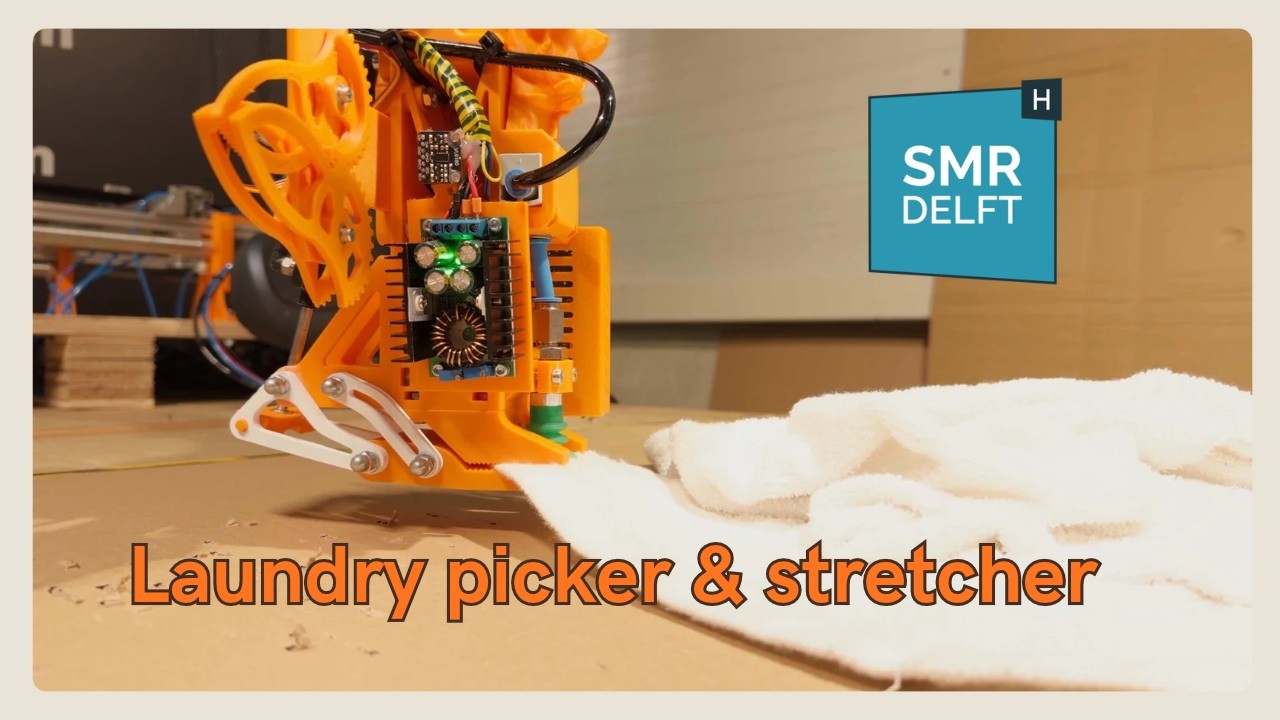
This project focuses on developing a proof of concept for automating the picking and stretching of towels in industrial laundries. Currently, towel stretching is often performed using large, expensive and enclosed machines. VTS LinQ challenged us to develop a more flexible robotic alternative.
The result is a system combining a Doosan robot, custom-designed grippers and AI-powered vision software to pick individual towels from a bulk supply, determine their orientation and stretch them ready for the next stage of the laundry process.
The solution
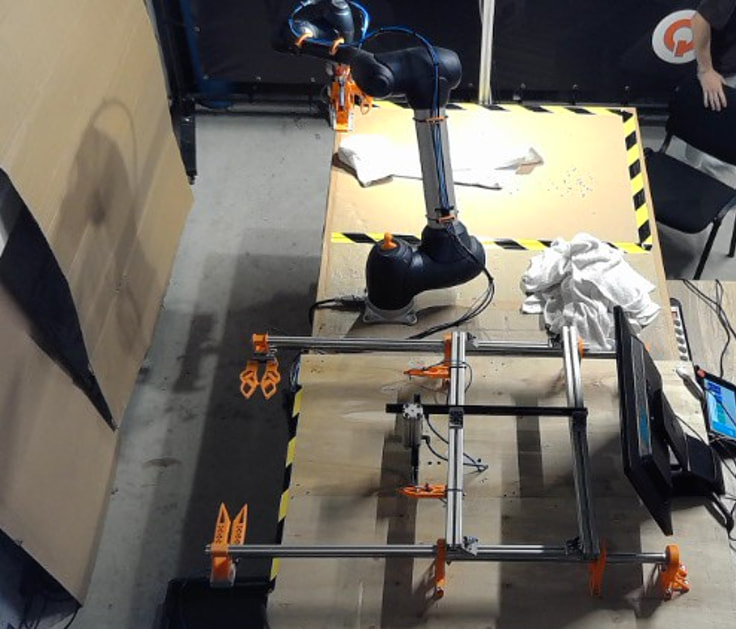
The Laundry Picker uses a Doosan robot equipped with a custom end-of-arm tool (EOAT) to singulate and pick up individual towels. Since towels are flexible and can fold or overlap, reliably identifying and picking their corners is one of the biggest challenges.
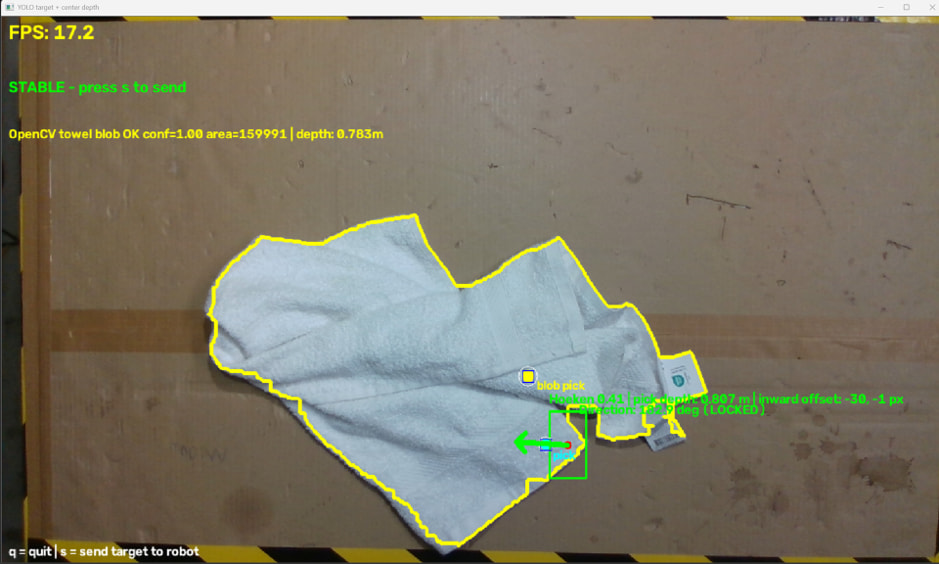
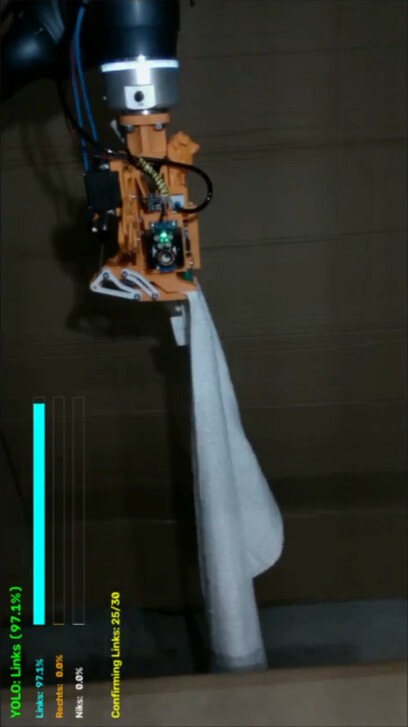
To solve this, we developed a vision system using Intel RealSense cameras and YOLO machine-learning models. The first camera detects towel corners and determines their position and orientation. After picking, a second camera checks whether the towel is correctly held and identifies which side of the towel is presented to the robot.
Based on this information, the robot selects the correct movement sequence and brings the towel to a mechanical stretching setup. If the towel is stretched correctly, it is transported further in the process by a conveyor belt. If the towel is stretched incorrectly on the conveyor belt, it is blown off and returned to the input of the system. In the current setup, the conveyor belt has not yet been integrated, so all towels are blown away after the stretching process.
First camera
Second camera
Mechanical design
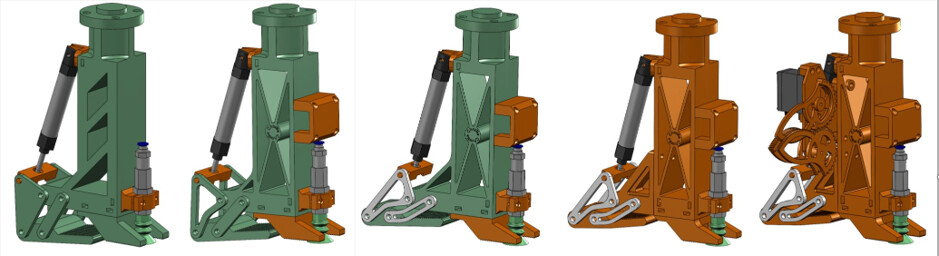
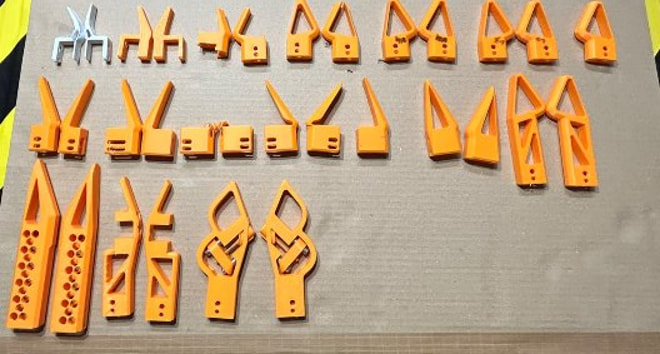
A major part of the project was developing the end-of-arm tooling and stretching clamps. Several iterations were made to improve the singulation of towels and prevent them from slipping out during stretching.
The stretching clamps also went through multiple design improvements. An initial design using small protrusions proved unreliable, as towels would fold or fall out. This was eventually replaced by a spring-based mechanism that guides and retains the towel more effectively.
End-of-arm tooling
Stretching clamps
Software and integration
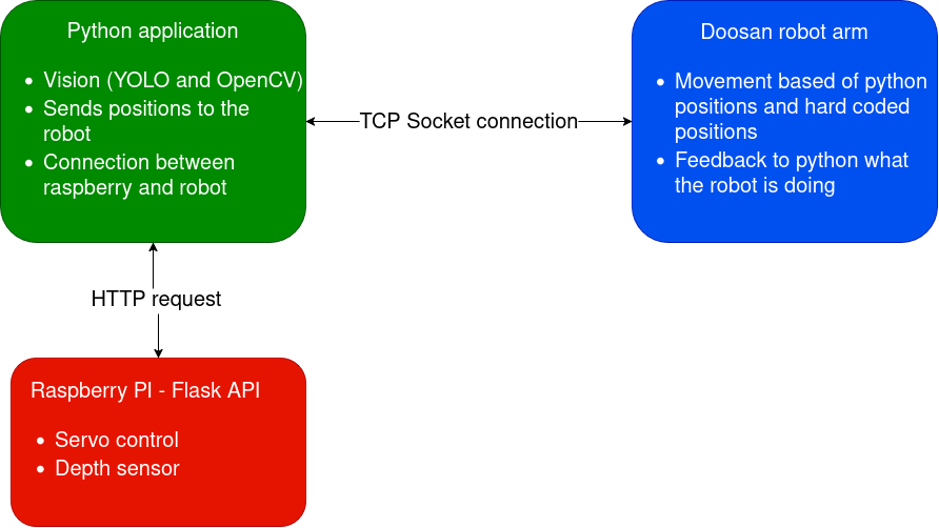
The system is controlled by a Python application that coordinates the cameras, vision models and robot movements. The vision software calculates the towel’s position using depth information and camera-to-robot calibration.
Python communicates with the Doosan robot through a TCP connection. This allows the system to exchange movement commands, inspection requests and completion signals.
If the towel is not correctly picked or the vision system cannot confidently identify its orientation, the robot can perform a rethrow and try again. This makes error detection and recovery an integrated part of the process.
Connection diagram
Final results
During the final testing phase, the system was evaluated over 98 towel cycles.
· 71% correctly stretched towels
· 1 rethrow per 2 towels on average
· 1:25 minutes average cycle duration
· 1:10 minutes optimal cycle duration
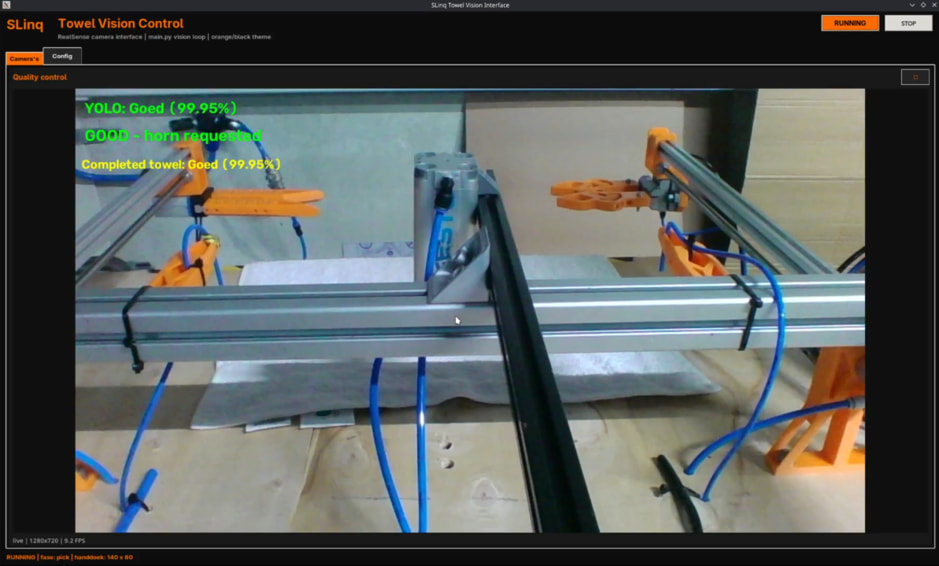
These results demonstrate the feasibility of automating towel picking and stretching using robotics and machine vision. Although reliability and cycle time can still be improved, the proof of concept provides a foundation for further development.
Stretched towel with quality control
Future recommendations
Several improvements could further improve the system’s performance:
· Introduce a separate singulation mechanism to reduce robot movements.
· Optimise robot movements and remove unnecessary waiting positions.
· Improve the layout by moving the stretching setup closer to the robot.
· Make the stretching mechanism adjustable to accommodate different towel sizes.
Customer quote
Enorm tof om te zien wat studenten binnen 6 weken voor elkaar kunnen boksen. Zelfs, of juist buiten hun eigen specialisme. Niet denken in problemen, maar alles ombuigen naar een uitdaging. En dat met enorm veel enthousiasme!