

Koen Molendijk | Stijn Stolwijk | Jamo Witt | Tom Marsdom | Bas van Wieringen | Tijn Francken | Mirko Bühlmann | Mathijs Cok
Kverneland announces concept for removing lasercut assembly products and loading them on deburring machine
Client: Kverneland Group
Location: Nieuw-Vennep, North Holland
Date: 3 November 2025
Overview
Kverneland Group, a leading developer of agricultural machinery such as spreading and spraying equipment, is taking the next step toward increased automation. To further optimize production efficiency, the company plans to automate the manufacturing process of laser-cut parts.
Current Situation
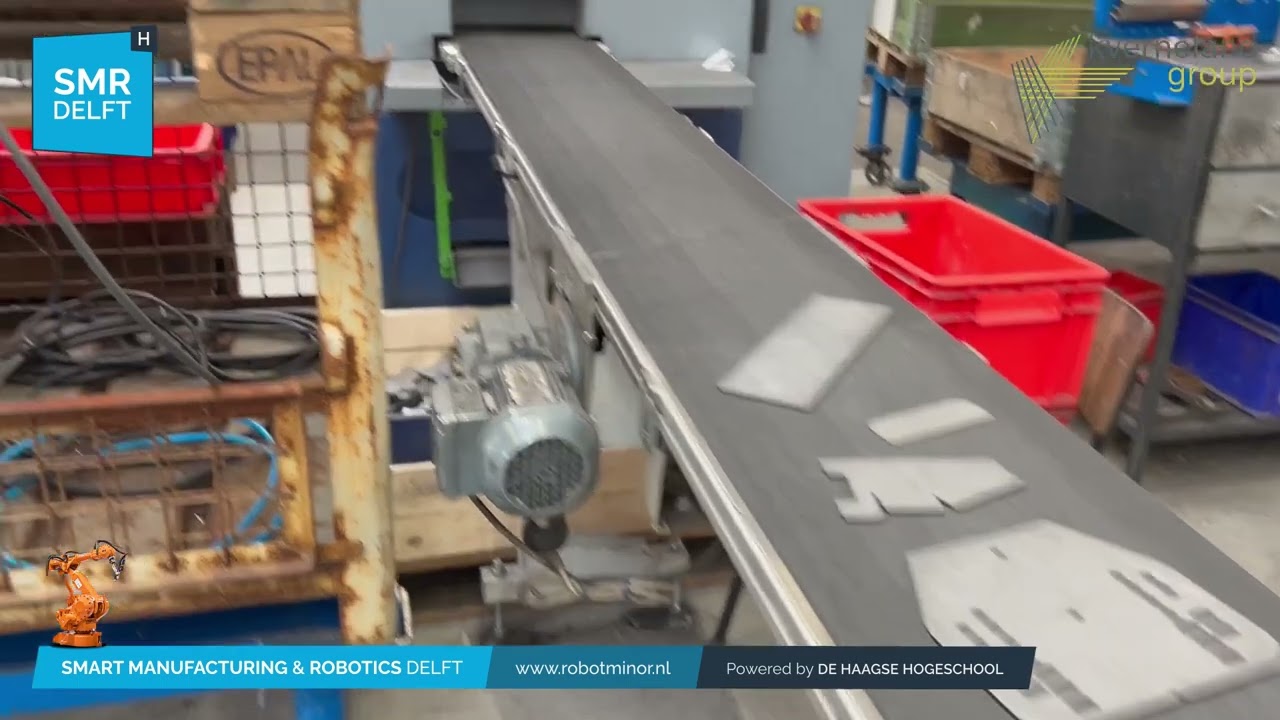
At present, the removal of laser-cut parts from sheet plates is performed manually. Operators must dislodge the parts from the sheets using a hammer, a process that is both labor-intensive and monotonous. In addition, the parts must be loaded onto the transport belt of the deburring machine, which moves at an extremely slow pace, making loading a time-consuming task.
In today’s labor market, companies face increasing challenges in recruiting personnel for repetitive and physically demanding work. While these positions are currently staffed at Kverneland, there is no guarantee this will remain the case in the future.
Proposed Solution
The manual hammering process will be replaced by a 2D gantry system equipped with a pneumatically actuated pin. Metal sheets containing laser-cut parts will be positioned on a transport belt that moves beneath the gantry. Eureka markers placed on each sheet will provide accurate positional data, allowing the system to identify the exact location of the plate under the gantry. The punching coordinates for each plate are preloaded into the control system. The transport belt will move incrementally until the pin can reach the corresponding coordinates, after which the parts will be released and fall onto the transport belt for subsequent deburring.
The unloading of deburred parts will be automated through the use of a collaborative robotic arm (cobot). This system will operate in conjunction with a vision camera capable of detecting and identifying the parts. Based on the system database, the cobot will sort the components into four designated containers: one for small-sized parts, one for medium-sized parts, one for large-sized parts, and one for unrecognized components that the program cannot classify automatically.
Current situation
Currently the laser-cut parts have to be removed out of the sheet plate manually. Workers are now punching out the parts of the sheets using a hammer. This is a labour-intensive and monotonous work. Furthermore the parts have to be loaded on the transportbelt of the deburring machine which is moving at a snailpace, so loading is a time-consuming process.
In modern times companies are struggling to find workers for labour-intensive and monotonous work. The current positions are now filled at Kverneland but can that be said in the future?
Solution
The hammer-process will be replaced by 2D gantry equipped with pneumatic powered pin. The sheet of metal with parts will be laid on a transportbelt that moves under the gantry. The eruka-markers placed on the plate will give the exact information of the plate under the gantry. The (punch)coordinations of every plate are preloaded. The transportbelt will move until it is possible for the pin to hit the coordinates. The parts will fall subsequently on the transportbelt to get deburred.
Offloading deburred parts will be done with a cobotarm. This process works in combination with a camera, which will allow tracking and recognizing of the parts. In accordance with the database the parts will sorted in 4 containers. One for small-size parts, one for medium-sized parts and one for large-sized parts. The last container is for situations when the program doesn’t recognises the part.