

Sinan Kocbag | Max Hoppezak | Jente de Bruin | Youssef Ouali
PATS Indoor Drone Solutions Announces Automated Quality Control System for Trap Eye to Enable Greenhouse Growers to Monitor Insect Populations More Reliably.
Robotic arm–based quality control inspection system improves the manufacturing process.
Date: 15. April 2026
Group: Sinan Kocbag | Max Hoppezak | Jente de Bruin | Youssef Ouali
Context
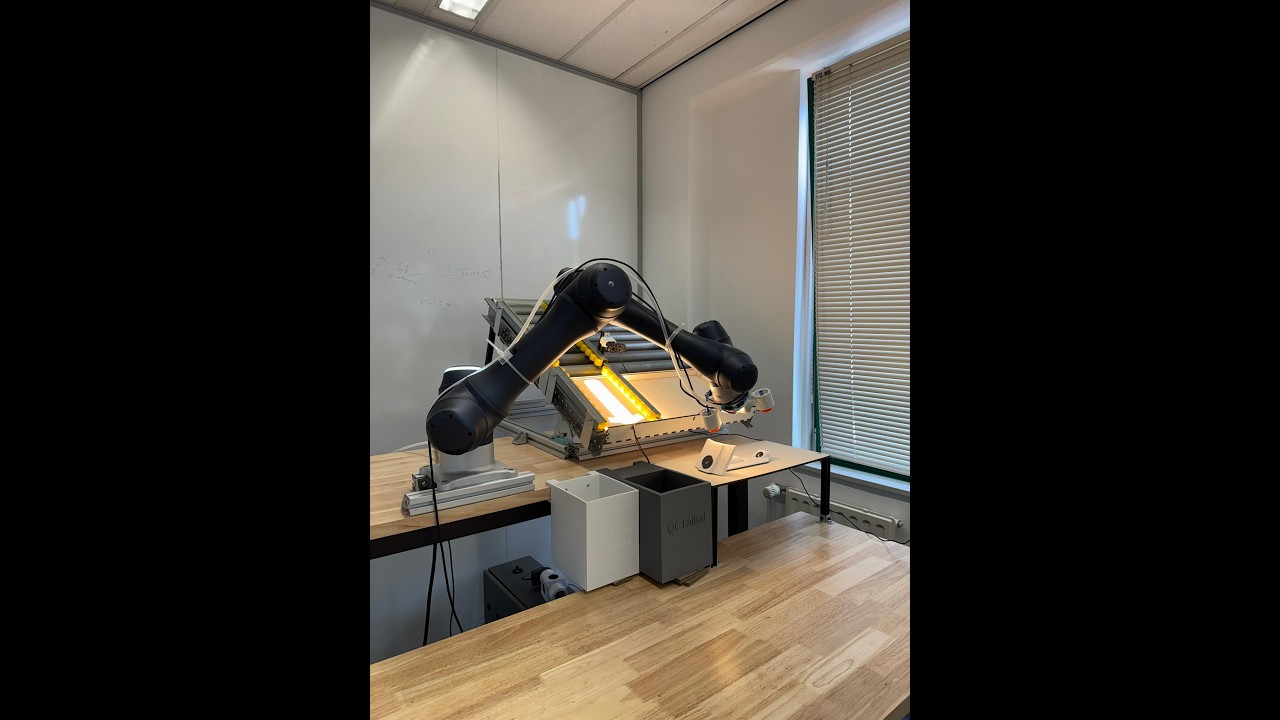
PATS Indoor Drone Solutions today announced the development of an automated quality control system for its Trap Eye insect monitoring device. The new system uses a robotic arm to perform automated inspections during production, ensuring consistent quality and reliability of the devices used in greenhouses. Trap Eye helps growers monitor insect populations by counting insects captured in traps, providing valuable data for pest management. With this automated quality control process, PATS aims to improve production efficiency while maintaining high standards of accuracy and reliability.
Challenges
The first challenge is that manual inspection limits production scalability. As demand for Trap Eye devices increases, performing detailed quality checks by hand slows down the production line and makes it difficult for PATS to increase output efficiently.
The second problem our product solves is eliminating the possibility of human error in the quality checks. This is an annoying problem which forces the company to spend time sending replacements in the event a faulty product makes it to the consumer.
A third challenge is the lack of consistent and traceable inspection data during manual quality control. When inspections are performed manually, results are often not recorded in a standardized way, making it difficult to track product performance over time. This limits PATS’ ability to identify recurring production issues, analyze failure patterns, and continuously improve the manufacturing process.
Solution
The proposed solution elegantly addresses the key challenges of scalability, consistency, and data tracking through a fully automated quality control (QC) system. At its core, the system integrates buffers, robotic handling, and vision-based inspection to create a flexible and reliable workflow. The first challenge, scalability, is solved through the use of modular buffer systems. By incorporating additional buffers and robots, the system can easily adapt to increased production output. This ensures that the QC process can scale alongside manufacturing demands without requiring significant redesign. The second challenge, human error, is addressed by removing the human element from the QC process. Robots perform repetitive tasks with high precision and consistency. Once properly programmed, the system minimizes variability and significantly reduces the likelihood of errors compared to manual inspection. The third challenge, data tracking and analysis, is solved by implementing a data logging function within the system. Each Trap-Eye unit is recorded after inspection, and its data is stored in a database. This information can later be used by data processing systems to identify patterns and pinpoint potential production issues. The system operates as follows: Trap-Eye units, placed in carriers, are first stacked in a buffer. At the end of the buffer, a light table activates the internal camera of each unit, allowing it to capture an image of the QC card. The QC card is then removed and sorted into the appropriate buffer. Once the image is sent to and stored in the database, the Trap-Eye is picked up and positioned in front of a camera to scan its QR code, linking it to the stored data. Next, the unit is placed on an inspection platform where a vision system checks for the presence of critical components, such as the magnet and screw. It also verifies whether the glass cover over the internal camera is correctly installed. If the Trap-Eye passes all checks, it proceeds to the packaging stage. If it fails, it is directed to a rejection buffer. Finally, the empty carrier is removed, completing the process cycle
How it Works
- To start using the system, the customer integrates it into their existing production line by installing the buffer, robotic handling system, and vision system, which is integrated into both the end effector and the buffer. The system is modular, allowing it to be adapted to different layouts and production speeds.
- Since the software is already fully developed, setup mainly consists of calibrating the cameras and connecting the system to the customer’s database.
- During operation, the customer places Trap-Eye units in carriers into the buffer.
- The integrated light table within the buffer triggers the internal camera to capture the QC card image, which is automatically stored in the database.
- The system then scans the QR code to link each product to its data.
- Next, the Trap-Eye is inspected using the integrated vision system, which checks for the presence and correct placement of key components, such as the magnet, screw, and glass cover.
- Based on this inspection, approved products are sent to packaging, while rejected ones are automatically sorted into a rejection buffer.
- This fully automated process ensures consistent quality control, reduces human error, and provides reliable data for monitoring and improving production.
Customer Quote
Our biggest challenge was the time it took to perform quality control manually. It slowed down our production significantly, and scaling up was difficult without adding more personnel. Our goal is to fully automate both the QC and packaging process to increase efficiency and keep up with demand. This solution gives us a strong starting point to achieve that. It automates key parts of the inspection and handling process, reducing manual work and improving consistency. On top of that, it’s flexible enough for us to build upon and further optimize, helping us move closer to a fully automated production line.